

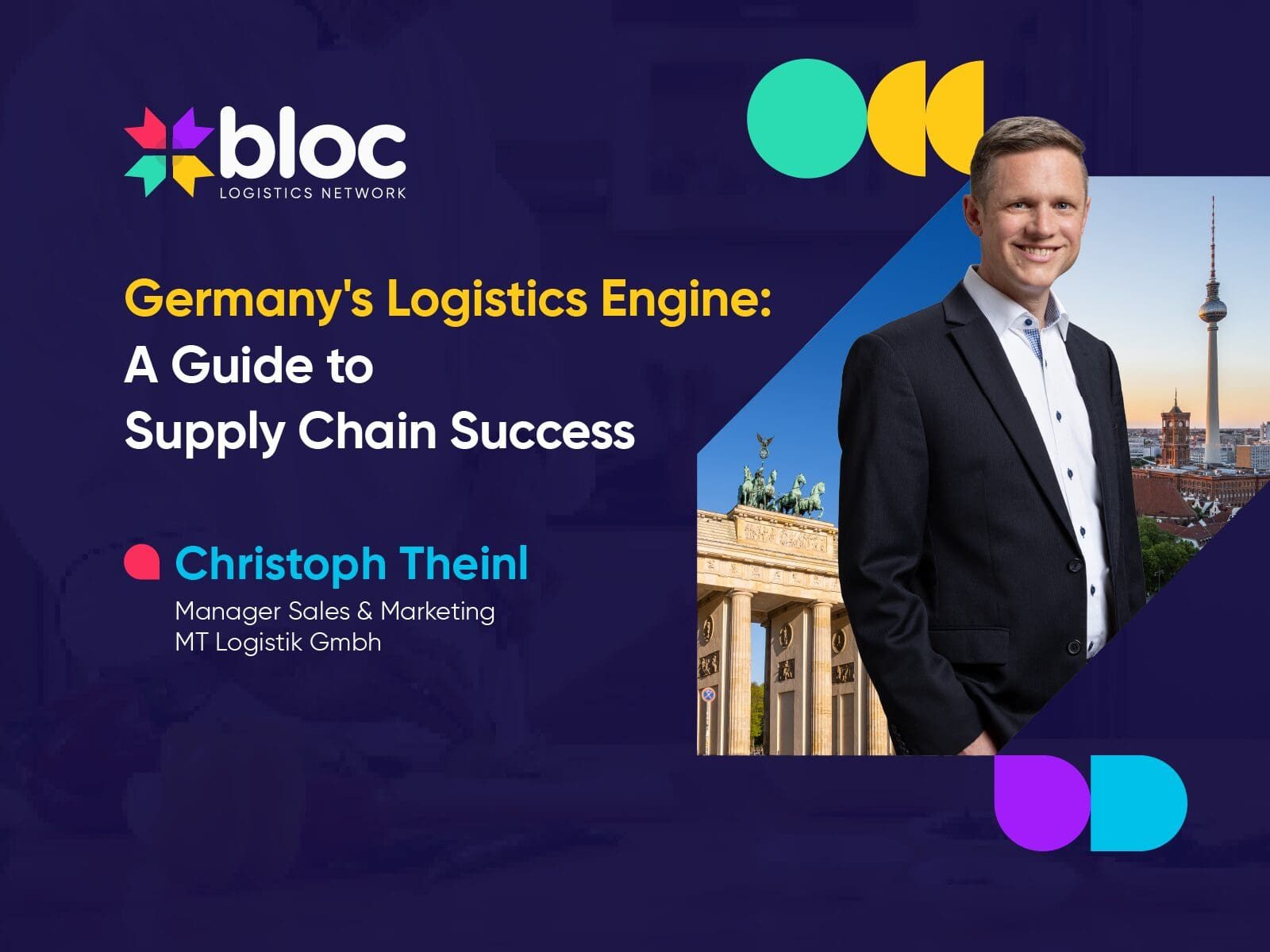
By Christoph Theinl, Manager Sales and Marketing at MT Logistik GmbH
When global businesses think of Germany, they envision precision engineering, automotive excellence, and a powerful economic engine at the heart of Europe. What underpins this industrial might is a logistics and freight forwarding ecosystem of unparalleled sophistication and efficiency.
Germany is not merely a transit country; it is the central nervous system of the continent’s trade, a complex network of infrastructure, industry, and innovation that demands deep local expertise to navigate successfully.
The Engine of Europe: Understanding Germany’s Unique Logistics Landscape
In an era of supply chain disruption, geopolitical shifts, and increasing demands for sustainability, understanding the nuances of the German market is more critical than ever. It’s a landscape where historical industrial strength meets cutting-edge digitalization, and where regulatory precision can be either a barrier or a competitive advantage. To unlock its full potential, you need more than a carrier; you need a strategic partner on the ground.
“Many see Germany as a single, efficient machine. In reality, it’s a collection of highly specialized regional powerhouses, each with its own rhythm, strengths, and logistical challenges,” explains Christoph Theinl, a seasoned logistics expert from MT Logistik GmbH. “From the air cargo velocity of Frankfurt to the industrial heartland we call home, success here is about granular knowledge and agile execution. You must understand not just the ‘how’ of moving freight, but the ‘why’ behind its journey.”
More Than a Location: Germany’s Three Pillars of Strength
Germany’s dominance in European logistics isn’t an accident. It’s built on a foundation of three interconnected pillars: unparalleled infrastructure, a unique industrial fabric, and a culture of unwavering quality.
1. Infrastructural Supremacy
Germany’s geographical position is a clear advantage, but it’s the quality of the infrastructure that transforms this location into a strategic asset. The country boasts world-class air cargo hubs, a dense Autobahn system, and an extensive rail network that is the cornerstone of sustainable, intermodal transport.
2. The Power of the “Mittelstand”
While global giants are well-known, the true backbone of the German economy is the Mittelstand—a network of small and medium-sized enterprises (SMEs). These are often highly specialized, world-leading companies in niche manufacturing sectors. Their logistical needs are unique: they require precision, flexibility, and partners who understand the value of their highly engineered products.
“Working with the Mittelstand is fundamentally different from dealing with a large multinational,” Christoph notes. “Their supply chains are intricate and often built on decades of trusted relationships. They don’t just need a forwarder; they need a consultant who can provide customized solutions. Reliability isn’t a goal; it’s the absolute baseline.”
3. A Culture of Quality and Precision
The cliché of “German efficiency” holds true in logistics. This translates to a low tolerance for errors, a strong emphasis on process optimization, and a regulatory environment that prizes order and compliance. For freight forwarders, this means meticulous documentation, proactive communication, and an unwavering commitment to meeting deadlines are non-negotiable.
Strategic Hubs: Global Gateways & Germany’s Heartland
While MT Logistik operates across Germany, its strategic locations in Frankfurt, Munich, and its headquarters in Wetzlar provide a perfect lens through which to view the country’s diverse logistics capabilities.
Frankfurt: The Pulse of Global Air Cargo
Frankfurt Airport (FRA) is more than an airport; it is a city dedicated to logistics. As Europe’s busiest cargo airport, its strategic importance lies in its incredible connectivity and speed for time-sensitive goods like pharmaceuticals, automotive components, and high-tech electronics.
“Frankfurt is the central nervous system for time-sensitive cargo in Europe,” states Christoph. “It’s a 24/7 environment where minutes matter, and having a team on the ground to personally oversee critical shipments is invaluable for success.”
Munich: The Gateway to Industrial Bavaria and Beyond
Munich represents the nexus of high-tech industry and European trade. A powerhouse in sectors like automotive, aerospace, and IT, its logistics ecosystem is finely tuned to support these demanding industries. Its location also makes it a natural gateway to Austria, Italy, and the burgeoning markets of Central and Eastern Europe.
“Munich’s logistics profile is about synergy,” Christoph explains. “It’s about serving the advanced manufacturing clusters on its doorstep while simultaneously acting as a critical distribution hub for southern Europe, combining air, road, and rail for the most efficient route.”
Wetzlar: The Hub of Precision and the Mittelstand
Our headquarters, Wetzlar, perfectly embodies the spirit of the German Mittelstand. Located right in the middle of Germany, it is an ideal hub for coordinating logistics nationwide. Wetzlar is globally recognized as the center of Germany’s optical industry—it’s the city where the legendary Leica camera was invented and is still produced today. This heritage of precision and high-value manufacturing defines the region.
“Wetzlar is where we come from; it’s our anchor,” says Christoph proudly. “Operating from the heart of this industrial region gives us a unique perspective. We are deeply integrated with the specialized SMEs that power Germany’s economy. Our location here isn’t just a pin on a map; it allows us to provide the perfect logistical backbone for the champions of German engineering.”
The Modern Challenges: Sustainability, Digitalization, and Resilience
While Germany’s foundations are strong, the ground is shifting. Three major trends are redefining the future of freight forwarding in the country.
1. The Green Imperative (Nachhaltigkeit)
Sustainability is no longer a talking point in Germany; it is a core business principle backed by legislation. At MT Logistik, this is a principle we actively embrace. Beyond simply advising clients, we are deeply committed to environmental protection through concrete actions like fleet modernization, route optimization to reduce mileage, and offering customized carbon-footprint reporting.
“Our clients are asking for sustainable options, and we believe it’s our responsibility to provide them,” says Christoph. “This is where our expertise becomes crucial. We actively help clients shift from road to rail for certain lanes and consolidate freight to maximize efficiency. For us, being sustainable is a core part of being a reliable, forward-thinking partner.”
2. The Drive for Digitalization (Industrie 4.0)
Germany is at the forefront of the fourth industrial revolution, where manufacturing and logistics are becoming increasingly interconnected. This demands a new level of technological integration from logistics partners, including real-time visibility, predictive analytics, and seamless data exchange.
3. Building Resilient Supply Chains
Recent global events have put supply chain resilience at the top of every company’s agenda. Businesses need partners who can help them map risks and build contingency plans, from establishing alternative routes to having the agility to switch between transport modes at a moment’s notice.
“The conversation has shifted from ‘cheapest’ to ‘most resilient’,” Christoph concludes. “This is where a network like Bloc Logistics truly shines—our deep local knowledge in Germany, combined with the global reach of our partners, allows us to build these robust, future-proof solutions for our clients.”
Germany remains a land of immense opportunity, but its complexity demands more than a one-size-fits-all approach. With our headquarters in the industrial heartland of Wetzlar and strategic locations in the key hubs of Frankfurt and Munich, MT Logistik GmbH embodies this principle.
We combine the precision and reliability expected in the German market with the flexible, client-centric approach needed to thrive in today’s dynamic global environment. For members of the Bloc Logistics Network and their clients, this means having a trusted partner ready to unlock the full potential of Europe’s most powerful economic engine.

Article by Christoph Theinl
Manager Sales and Marketing,
MT Logistik GmbH, a member of Bloc Logistics Network
MT Logistik GmbH is a Germany-based freight forwarder specializing in air and ocean freight. As a certified IATA agent handling 5,000+ tons of airfreight annually, they operate in-house X-ray and sniffer equipment for secure, efficient processing. With fast customs clearance by trained staff and rapid quote turnaround, MT Logistik offers reliable solutions across air, sea, road, warehousing, project cargo, perishables, pharma, and dangerous goods.
Bloc Logistics Network is a global platform that connects logistics professionals to share opportunities and collaborate without barriers. Bloc aims to level the playing field by creating an accessible, supportive environment where professionalism and collaboration drive real results. It serves as an ecosystem designed for mutual advancement, ensuring growth, efficiency, and success across the logistics industry.