

By Leslie Nguyen, Deputy Director, AO Shipping Transport Corporation
The global logistics landscape is undergoing a tectonic shift. For decades, the world’s manufacturing heart beat primarily in one place, but today, a new rhythm is emerging from Southeast Asia.
At the center of this transformation is Vietnam, a nation that has evolved from a regional exporter into a primary cornerstone of the “China Plus One” strategy. As businesses worldwide look to diversify their supply chains and mitigate risks, Vietnam has stepped up to offer not just a secondary option, but a world-class logistics alternative.
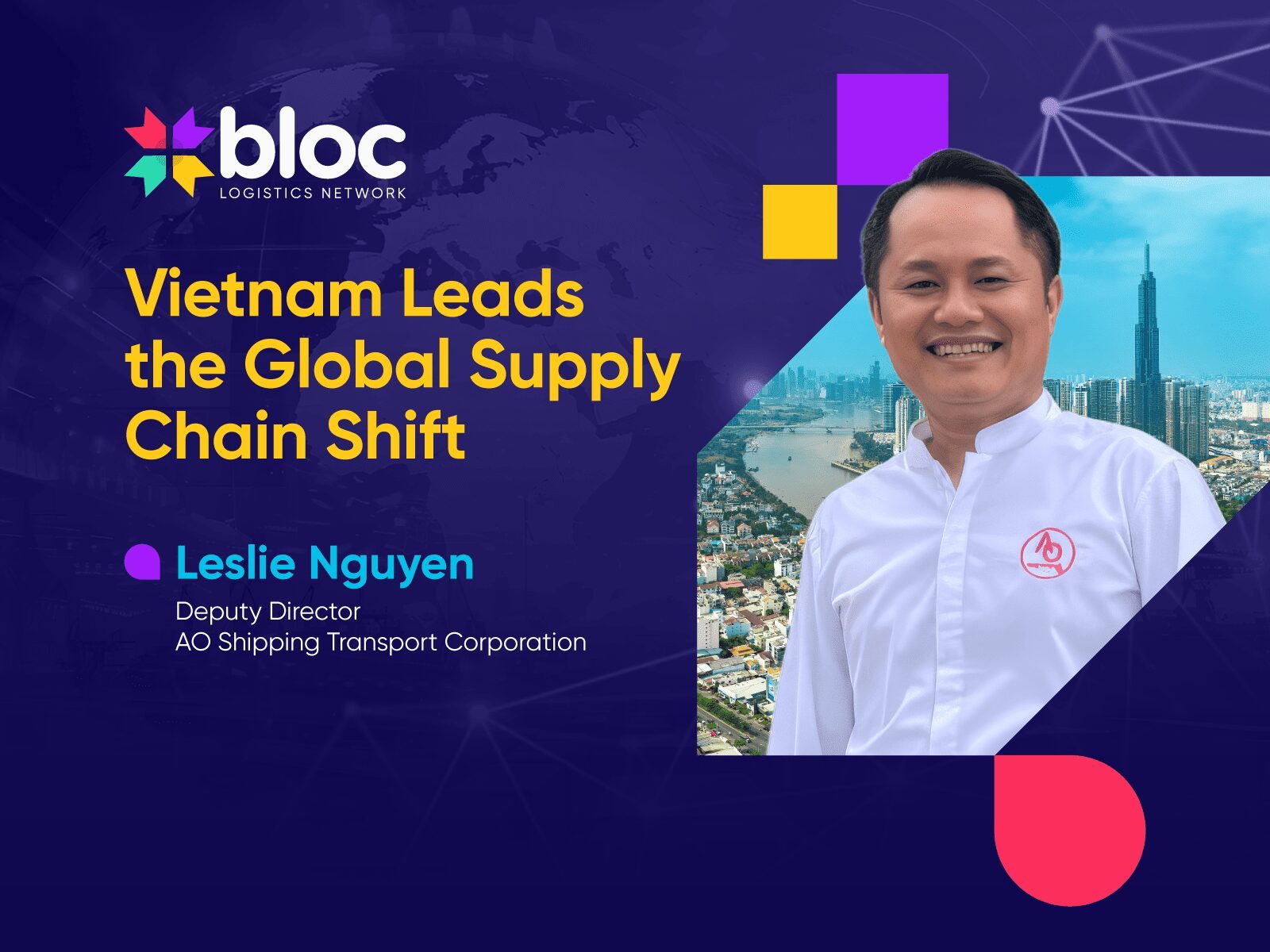
At Bloc Logistics Network, we understand that navigating a market as dynamic as Vietnam requires more than just a map; it requires the deep-rooted expertise of local leaders who understand the nuances of the terrain. One such leader is Leslie from AO Shipping, based in the bustling economic hub of Ho Chi Minh City. With a career dedicated to optimizing the flow of goods in and out of Vietnam, Leslie provides a unique vantage point on how this nation is reshaping global trade.
The Rise of the China Plus One Strategy
The move toward Vietnam isn’t a temporary trend; it is a structural realignment of global commerce. Over the last five years, geopolitical tensions and the need for supply chain resilience have driven multinational corporations to seek manufacturing bases outside of traditional hubs. Vietnam, with its strategic coastline, competitive labor, and aggressive pursuit of free trade agreements, has become the natural beneficiary.
According to Leslie, this shift has fundamentally changed the expectations placed on freight forwarders. “We are seeing a massive influx of diverse industries moving their primary production to Vietnam. It is no longer just about textiles. We are now handling high-end electronics, sophisticated furniture, and complex machinery. This shift requires a forwarder who doesn’t just move boxes but understands the technical requirements of these specific industries.”
The numbers tell a compelling story. Vietnam’s exports to the United States alone surged significantly in the last year, with a notable increase in a wide array of commodities. This growth is supported by a government that is deeply committed to trade liberalization, participating in landmark agreements like the CPTPP and the EVFTA, which provide Vietnamese goods with preferential access to the world’s largest markets.
Infrastructure as a Catalyst for Growth
A nation’s logistics potential is only as strong as its infrastructure, and Vietnam is currently in the midst of an unprecedented building boom. The government’s National Strategy for the Development of Vietnam’s Logistics Services (2025–2035) aims to transform the country into a regional powerhouse. At the heart of this strategy are “mega-projects” that are set to redefine transit times and capacity.
One of the most anticipated developments is the Long Thanh International Airport. Located just outside Ho Chi Minh City, this $13 billion project is designed to eventually handle 100 million passengers and five million metric tons of cargo annually. With its first official flights recently taking place in late 2025, the airport is poised to relieve the pressure on the aging Tan Son Nhat Airport and provide a dedicated gateway for air freight.
“The opening of Long Thanh is a game-changer for the region,” Leslie notes. “It represents a level of connectivity we haven’t seen before. For our clients, this means faster turnaround times and more options for air-to-sea multimodal transport. It’s about building a future where Vietnam isn’t just a destination, but a global transit hub.”
Beyond the skies, the maritime sector is seeing similar advancements. The Cai Mep-Thi Vai port cluster in Ba Ria-Vung Tau province has become one of the few ports in Southeast Asia capable of receiving the world’s largest container ships. By bypassing the need for transshipment in Singapore or Hong Kong, shippers can save days in transit time and significantly reduce costs.
Ho Chi Minh City: The Engine of Southern Logistics
Ho Chi Minh City (HCMC) remains the beating heart of Vietnam’s economy. As the primary gateway for the southern provinces, HCMC handles the lion’s share of the nation’s container traffic. The city is surrounded by a massive network of industrial parks that feed into its ports and airports, creating a high-density logistics ecosystem.
However, growth brings challenges. Congestion and urban bottlenecks have historically been hurdles for the region. To combat this, the Ben Luc-Long Thanh Expressway and several new ring roads are being completed to bypass the city center, allowing cargo to move seamlessly from factories to the coast.
For Leslie and the team at AO Shipping, proximity to these hubs is vital. “In Ho Chi Minh City, logistics is a game of precision. You have to know the port schedules, the gate-in times, and the local traffic patterns perfectly. Being based here allows us to offer real-time solutions. If a truck is delayed or a vessel schedule changes, we are on the ground to manage the situation immediately.”
This local presence is what distinguishes independent forwarders within the Bloc Logistics Network from the larger, more bureaucratic multinational corporations. While a global giant might see a shipment as a number, a local expert sees the human and economic impact of every container.
Specialized Logistics: Beyond General Cargo
As Vietnam’s economy matures, the demand for specialized logistics has skyrocketed. It is no longer enough to offer standard FCL (Full Container Load) or LCL (Less than Container Load) services. High-value and sensitive goods require specialized handling, and this is where AO Shipping has carved out a significant niche.
Vietnam is a global leader in the export of furniture and seafood, two industries with vastly different logistical needs. Furniture requires meticulous packing and moisture control to ensure products arrive in pristine condition at retail centers in Europe and North America. On the other hand, the seafood and perishables industry demands a robust cold chain.
“We take great pride in our reefer cargo capabilities,” Leslie explains. “Handling perishable goods within a strict temperature range, whether it’s -25°C for frozen seafood or specific settings for fresh fruit, requires constant monitoring and a zero-failure mindset. At AO Shipping, we manage the entire chain from the processing plant to the final destination. In this business, there is no room for error.”
This focus on quality is a core pillar of Leslie’s business philosophy. “In Vietnam, the market is competitive, and many will offer the lowest possible price. But we always tell our clients: you get what you pay for. True logistics success isn’t just about the lowest rate; it’s about the security of the supply chain and the reliability of the partner you choose. We don’t just move cargo; we protect our clients’ reputations.”
Navigating Customs in Vietnam
For many international businesses, the primary barrier to entry in Vietnam is not the physical movement of goods, but the complexity of the regulatory environment. Customs clearance in Vietnam involves a intricate web of documentation, HS code classifications, and local compliance standards that can be daunting for the uninitiated.
Vietnam has made significant strides in digitalizing its customs processes through the ASEAN “Single Window” system, but the human element remains essential. Misclassifying a product or failing to provide the correct certificate of origin can lead to costly delays, fines, or even the seizure of goods.
“Customs in Vietnam is about more than just paperwork; it’s about relationships and local knowledge,” Leslie emphasizes. “Our team acts as a bridge between our clients and the authorities. We anticipate the questions that will be asked and ensure every document is perfect before it even reaches the desk of a customs officer. This proactive approach is what keeps the supply chain moving.”
By leveraging deep local expertise, AO Shipping helps international partners navigate these hurdles, ensuring that the benefits of manufacturing in Vietnam aren’t eroded by administrative delays.
Looking Ahead: The 2035 Logistics Strategy
The future of Vietnam logistics is green, digital, and integrated. The government’s 2035 vision isn’t just about building more roads; it’s about “Smart Logistics.” This includes the adoption of AI for route optimization, blockchain for transparent tracking, and the development of “Green Ports” that utilize renewable energy.
Digital transformation is already taking root.
At AO Shipping, the integration of real-time tracking and automated quoting systems has become standard. “The industry is moving toward a model where data is as important as the physical cargo,” says Leslie. “Our clients want to see where their goods are at every moment. We are investing heavily in technology to provide that level of transparency, but we also ensure that technology never replaces the personal touch our clients value.”
Furthermore, as the European Union and the United States implement stricter carbon reporting requirements (such as the EU ETS), Vietnamese logistics providers are beginning to pivot toward more sustainable practices. This includes optimizing truck routes to reduce emissions and exploring inland waterway transport as a lower-carbon alternative to road freight.
The Power of Local Expertise
Vietnam is no longer a “frontier market.” It is a sophisticated, rapidly evolving logistics hub that is essential to the modern global economy. However, the very speed of its growth creates a landscape that is constantly shifting. To succeed here, you need a partner who is not just watching the market from afar, but is an active participant in its daily evolution.
Leslie and the team at AO Shipping represent the best of the Bloc Logistics Network: experts who combine global standards with local mastery. Whether it is navigating the new air corridors of Long Thanh, managing the complexities of a reefer shipment, or ensuring a smooth customs clearance in Ho Chi Minh City, their dedication to quality and reliability is what drives success for their partners.
As Vietnam continues to lead the global supply chain shift, having a trusted expert on the ground is the most valuable asset a freight forwarder can have. At Bloc Logistics Network, we are proud to highlight members like Leslie, who are not just moving the world’s goods, but are building the future of global trade.
“Our motto is ‘Be Your Partner of Success’,” Leslie concludes. “We believe that when our partners grow, we grow. Vietnam is full of opportunity, and we are here to ensure that our fellow network members can tap into that potential with confidence and peace of mind.”

Article by Leslie Nguyen
Deputy Director,
AO Shipping Transport Corporation
AO Shipping Transport Corporation is a Vietnam-based freight forwarder offering sea, air, domestic trucking, customs clearance and project cargo services. True to its name “All in One,” the team delivers professional, cost-effective logistics solutions built on attitude, self-improvement and a commitment to serve. With a focus on value and reliability, AO Shipping combines smart pricing with strong execution to meet customer needs in and out of Vietnam.